
Light, Mirror, Lenses and Human Eyes
light travels in a straight line, and its interaction with objects creates shadows and images. It defines
- Pole (P): Midpoint of mirror surface
- Centre of Curvature (C): Centre of the sphere mirror
- Principal Axis: Line joining P and C
- Focus (F): Point where rays converge or appear to diverge
- Focal Length (f): Distance between P and F
The relationship between radius of curvature (R) and focal length (f) with the formula R = 2f
Laws of reflection:
- Angle of incidence = Angle of reflection
- Incident ray, normal, and reflected ray lie in the same plane
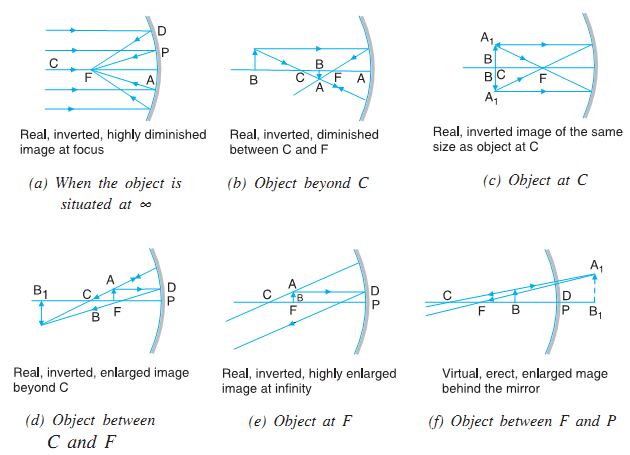
Image Formation – Various object positions
Concave Mirrors
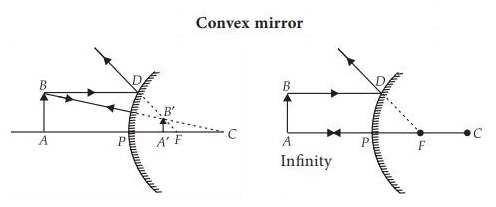
Convex Mirrors
Concave and Convex mirror uses
- Concave Mirror Uses: Torches, shaving, headlights, dentist mirrors, solar furnaces.
- Convex Mirror Uses: Rear-view mirrors (wide view).
Formula
- The mirror formula: 1/f = 1/v + 1/u
- The magnification formula is: m = h′/h = (-v)/u
Laws of Refraction of Light
- Law 1: The incident ray, refracted ray, and the normal to the interface of two transparent media all lie in the same plane.
- Law 2 (Snell’s Law): (sin i/sin r) = constant (This constant is known as the refractive index for the given pair of media and light colour)
The Refractive Index
Refraction occurs because light travels at different speeds in different media.
- Absolute refractive index: c/v (where c is speed of light in air/vacuum and v in the medium.)
- Medium refractive index : Air = 1.0003, Water = 1.33, Crown glass = 1.52, Diamond = 2.42
Light bends towards the normal when entering a denser medium (air to glass). It bends away from the normal when exiting to a rarer medium (glass to air). The emergent ray is parallel to the incident ray but laterally displaced.
Optical Density vs Mass Density – Optical density is not equal to mass density. Kerosene has higher optical density than water but lower mass density.
Lenses
A lens is a transparent material bounded by two surfaces, at least one of which is spherical.
- Convex lens : Thicker in the middle, converges rays. (Also called converging lens)
- Convex Lens converges parallel rays to a point called the principal focus. The point on the axis is the focal point (F). The focal length (f) is the distance between the lens and F.
- Convex lenses have two principal foci – F1 and F2, and the same applies to concave lenses.
- Concave lens: Thicker at edges, diverges rays. (Also called diverging lens)
- Concave Lens diverges parallel rays such that they appear to come from a point on the axis—the virtual focus.
A lens has two centres of curvature (C₁ and C₂) and one principal axis. The optical centre is the central point of the lens.
Concex Lens
| Object Position | Image Position | Image Size | Nature |
|---|---|---|---|
| At infinity | At focus F2 | Highly diminished | Real and inverted |
| Beyond 2F1 | Between F2 and 2F2 | Diminished | Real and inverted |
| At 2F1 | At 2F2 | Same size | Real and inverted |
| Between F1 and 2F1 | Beyond 2F2 | Enlarged | Real and inverted |
| At focus F1 | At infinity | No image | — |
| Between F1 & O | Same side as object | Enlarged | Virtual, erect |
Concex Lens
| Object Position | Image Position | Image Size | Nature |
|---|---|---|---|
| At infinity | At focus F1 | Highly diminished | Virtual, erect |
| Between infinity and optical center O | Between F1 & O | Diminished | Virtual, erect |
Formula
- Lens formula = 1/f = (1/v) – (1/u)
- Magnification (m) = m = h′/h = (v)/u
Power of a Lens
- Power P=1/f (f in metres) Unit: Dioptre (D), [1 D = 1 m⁻¹]
- Positive (Convex lens), Negative power (Concave lens)
- Lenses in combination: Total power P=P1+P2+P3+………Pn (Used in optical instruments, spectacles, microscopes, etc.)
Human Eyes
The eye functions like a camera, with its lens system focusing images onto the retina. Key components include the cornea, iris, pupil, crystalline lens, and retina. Iris controls the pupil size and regulates light entry. The ability of the eye to adjust its focal length, known as accommodation, allows us to see objects at varying distances. Least distance of distinct vision = 25 cm (for a normal adult eye).
Defects of vision:
- Hypermetropia (Farsightedness): Cannot see near objects clearly; corrected with convex lenses.
- Myopia (Nearsightedness): Cannot see far objects clearly; corrected with concave lenses.
- Presbyopia: Age-related loss of accommodation; often corrected using bifocal lenses.
Cataract: Clouding of the eye lens, treatable through surgery.
Dispersion is the splitting of white light into its colors. the separation of white light into its component colors (VIBGYOR).
Atmospheric refraction causes effects such as the twinkling of stars, advance sunrise, and delayed sunset. Stars appear to twinkle due to continuous refraction of their light through Earth’s atmosphere, which is not uniform. Planets, being closer and having a larger apparent size, do not twinkle.
Scattering of light explains the blue color of the sky and red appearance of the Sun during sunrise and sunset. Smaller particles scatter shorter (blue) wavelengths more, while larger particles scatter longer (red) wavelengths.
Tyndall Effect explains why light beams become visible in smoke/fog.
Related Links
- General Science : Questions for Competitive Exams 🔗
General Science, Study Materials, Current Affairs, Practice Questions,