
Biology Notes
Cell, The Fuldamental Unit of Life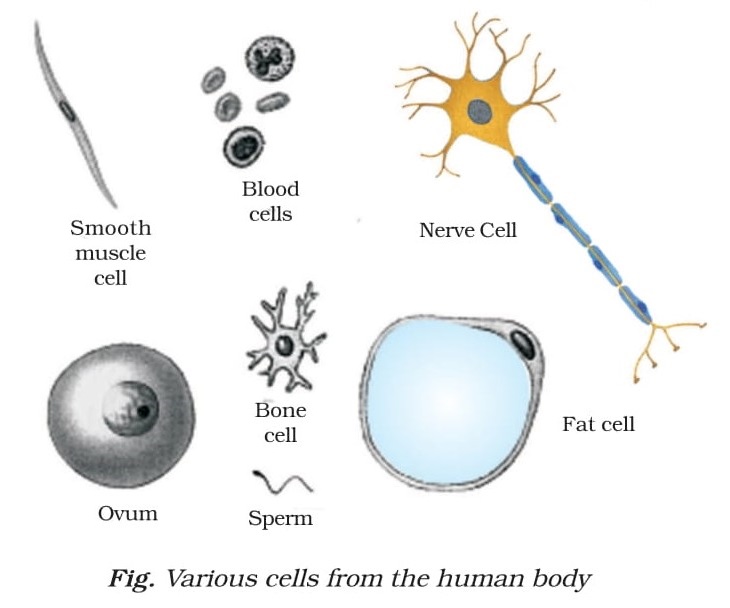
Cell shape and size vary depending on their function. For example, Amoeba can change its shape, while nerve cells have a fixed shape.
- Unicellular organisms (e.g., Amoeba, Chlamydomonas, Paramoecium) consist of a single cell.
- multicellular organisms (e.g., plants, animals) are made of many cells with specialized functions.
Important Discoveries:
- Robert Hooke (1665) first observed (dead) cells in a cork slice,
- Leeuwenhoek (1674) – free-living cells in pond water.
- Robert Brown (1831) – discovered the nucleus.
- Purkinje (1839) – coined the term protoplasm.
- Schleiden & Schwann – proposed the cell theory.
- Virchow (1855) – cells arise from pre-existing cells.
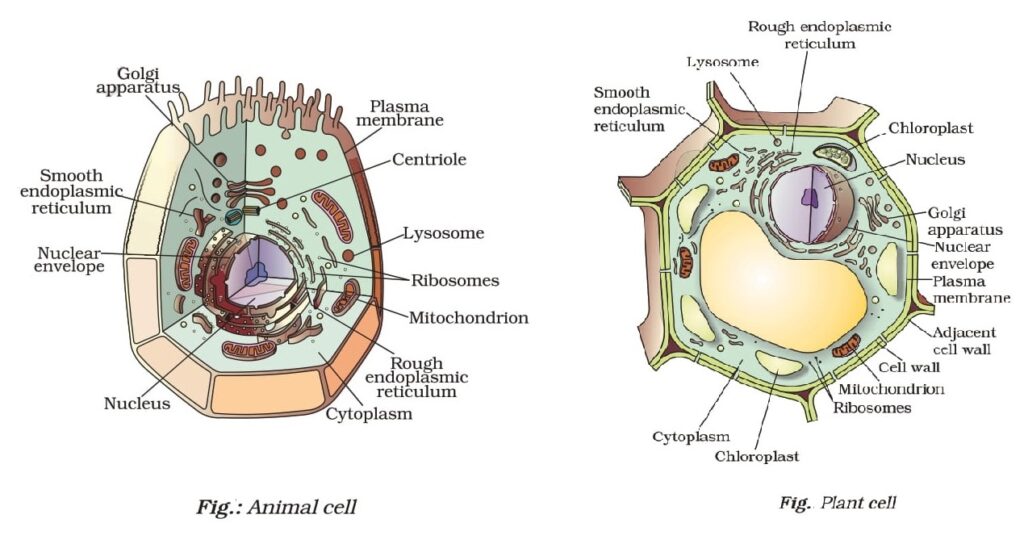
Cell Organelles – Cells perform life processes with the help of cell organelles, All cells contain three basic components: 1) Plasma membrane (or cell membrane), 2) Nucleus, 3) Cytoplasm.
- Plasma membrane (Cell Membrane) is the cell’s outer covering and is selectively permeable, allowing certain substances to pass in or out. Diffusion moves substances from high to low concentration, while osmosis is the diffusion of water through the membrane. Depending on the surrounding solution, cells may swell (hypotonic), remain unchanged (isotonic), or shrink (hypertonic).
- Nucleus – Cell’s control center. Enclosed by nuclear membrane with pores. Contains chromosomes (DNA + proteins), responsible for heredity. In non-dividing cells, DNA exists as chromatin; condenses into chromosomes during division. Eukaryotic cells – Have a well-defined nucleus. Prokaryotic cells (e.g., bacteria) – Lack nuclear membrane; contain nucleoid.
- Cytoplasm – Fluid inside the plasma membrane. Contains organelles (e.g., mitochondria, chloroplasts). In prokaryotes: organelles are unorganized, not membrane-bound. In eukaryotes: organelles are membrane-bound.
- Cell Wall – Found in plant cells, outside plasma membrane. Made of cellulose; provides rigidity and support. Plasmolysis: cell contents shrink away from wall when water is lost. Prevents bursting in dilute solutions (osmotic balance).
| Cell Organelles | Function |
|---|---|
| Nucleus | control center of the cell; it contains DNA and regulates all cellular activities. |
| Mitochondria | Powerhouse of the cell, produce energy ATP (Adenosine Triphosphate) – energy currency of the cell, Contains its own DNA and ribosomes – can make proteins. |
| Ribosome | responsible for protein synthesis |
|
Endoplasmic Reticulum (ER) |
ER is two types: Rough ER has ribosomes and helps in protein synthesis. Smooth ER has no ribosomes; synthesizes lipids and helps in detoxification. |
| Golgi Apparatus | packages proteins & other substances, sends them inside/outside the cell. |
| Lysosomes | Digest unwanted substances, known as the cell’s waste disposal system. |
| Vacuole | store water, food, and waste materials; they are larger in plant cells. Maintain turgidity in plant cells. In unicellular organisms (e.g., Amoeba), vacuoles store food and help remove waste. |
| Cytoplasm | A jelly-like fluid where all the organelles float and function. |
| Chloroplast | Found only in plants, perform photosynthesis, making food using sunlight. |
| Plastids | Found only in plant cells. Internal structure like mitochondria; also have DNA and ribosomes. Two main types:
|
Differences Between Prokaryotic and Eukaryotic Cells
| Feature | Prokaryotic Cell | Eukaryotic Cell |
|---|---|---|
| Size | Small (1–10 µm) | Large (5–100 µm) |
| Nuclear Region | Not well-defined, called nucleoid | Well-defined, enclosed in nuclear membrane |
| Chromosome | Single | Multiple |
| Organelles | Membrane-bound organelles absent | Membrane-bound organelles present |
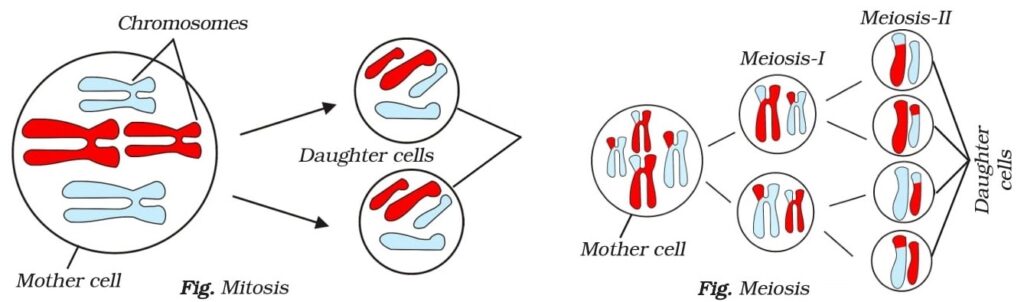
Cell Division – Process by which cells grow, repair, and reproduce. Two types: (01) Mitosis: makes two identical daughter cells – used for growth and repair. (02) Meiosis: makes four non-identical daughter cells with half the chromosomes – used for forming gametes.
k
What is plasmolysis? (A) Swelling of cell in salt solution (B) Shrinkage of cell content away from cell wall (C) Division of cell (D) Entry of water into cell
Which of the following is absent in prokaryotic cells? (A) Nucleoid (B) Cell wall (C) Membrane-bound organelles (D) Cytoplasm
What is the function of the plasma membrane? (A) Provides energy to the cell (B) Allows selective substances to pass (C) Stores food (D) Helps in cell division
Which process allows oxygen to enter the cell? (A) Active transport (B) Osmosis (C) Diffusion (D) Evaporation
What is the function of Rough Endoplasmic Reticulum (RER)? (A) Lipid synthesis (B) Protein synthesis (C) DNA replication (D) Enzyme breakdown
Which cell organelle is responsible for packaging and transporting proteins? (A) Lysosome (B) Mitochondria (C) Golgi apparatus (D) Ribosome
The function of lysosomes is to: (A) Produce ATP (B) Synthesize proteins (C) Digest waste and old organelles (D) Control cell division
What is the main role of smooth endoplasmic reticulum (SER)? (A) Protein synthesis (B) DNA formation (C) Lipid synthesis and detoxification (D) Cell division
Which of the following organelles contain their own DNA and ribosomes? (A) Mitochondria and Lysosome (B) Mitochondria and Plastids (C) Plastids and Golgi body (D) Nucleus and Vacuole
What is the main function of vacuoles in plant cells? (A) Photosynthesis (B) Respiration (C) Protein synthesis (D) Storage and maintaining turgidity
What type of cell division is responsible for the formation of gametes? (A) Mitosis (B) Binary Fission (C) Meiosis (D) Budding
For more Please visit Our YouTube Channel @ODEAcademy ▶️
Related Links
- General Science MCQs for Competitive Exams 🔗
- General Science Complete Study Material for Competitive Exams 🔗
General Science, Study Materials, Current Affairs, Practice Questions,
For More Updates ! Join ODEAcademy WhatsApp and Telegram Channel